Shop fromIndia’s Most Affordable Electronics Store
from Rs.99.00
Don't miss this special opportunity today.
Showing 129–144 of 262 resultsSorted by latest
The 74HC4543 high-speed silicon-gate device is a BCD to 7-segment latch/decoder/driver designed primarily for directly driving liquid-crystal displays. It has an active-high disable input (LD), an active-high blanking input (BI) and a phase input (PH) to which a square wave is applied for liquid-crystal applications. This square wave also is applied to the backplane of the liquid-crystal display. This device also can be used, in conjunction with current amplifying devices, for driving LEDs, incandescent, fluorescent, and gas-discharge displays. For these applications the phase input provides a means to obtain active-high or active-low segment outputs.
The CD54HC4511, CD74HC4511, and CD74HCT4511 are BCD-to-7 segment latch/decoder/drivers with four address inputs (D0−D3), an active-low blanking (BL) input, lamp-test (LT) input, and a latch-enable (LE) input that, when high, enables the latches to store the BCD inputs. When LE is low, the latches are disabled, making the outputs transparent to the BCD inputs. These devices have standard-size output transistors, but are capable of sourcing (at standard VOH levels) up to 7.5 mA at 4.5 V. The HC types can supply up to 10 mA at 6 V.
The 74HC4351; 74HCT4351 is a single-pole octal-throw analog switch (SP8T) suitable for use in analog or digital 8:1 multiplexer/demultiplexer applications. The switch features three digital select inputs (S0 to S2), eight independent inputs/outputs (Yn), a common input/output (Z) and two digital enable inputs (E1 and E2). With E1 LOW and E2 HIGH, one of the eight switches is selected (low impedance ON-state) by S0 to S2. The data at the select inputs may be latched by using the latch enable input (LE). When LE is HIGH the latch is transparent. When E1 is HIGH or E2 is LOW all 8 analog switches are turned off. Inputs include clamp diodes. This enables the use of current limiting resistors to interface inputs to voltages in excess of VCC.
Applications :-
- Analog multiplexing and demultiplexing
- Digital multiplexing and demultiplexing
- Signal gating
The 74HC423 is a dual retriggerable monostable multivibrator with output pulse width control by two methods. The basic pulse time is programmed by selection of an external resistor (REXT) and capacitor (CEXT). Once triggered, the basic output pulse width may be extended by retriggering (nA) or (nB). By repeating this process, the output pulse period (nQ = HIGH, nQ = LOW) can be made as long as desired. When nRD is LOW, it forces the nQ output LOW, the nQ output HIGH and also inhibits the triggering. Schmitt-trigger action in the nA and nB inputs, makes the circuit highly tolerant to slower input rise and fall times. The '423' is identical to the '123' but cannot be triggered via the reset input. Inputs include clamp diodes. This enables the use of current limiting resistors to interface inputs to voltages in excess of VCC.
The 74HC4072 is a high speed CMOS DUAL 4-INPUT OR GATE fabricated in silicon gate C2 MOS technology. It has the same highspeed performance of LSTTL combined with true CMOS low power consumption. The internal circuit is composed of 3 stages including buffer output, which gives high noise immunity and stable output. All inputs are equipped with protection circuits against static discharge and transient excess voltage.
The 74HC4066; 74HCT4066 is a quad single pole, single throw analog switch. Each switch features two input/output terminals (nY and nZ) and an active HIGH enable input (nE). When nE is LOW, the analog switch is turned off. Inputs include clamp diodes. This enables the use of current limiting resistors to interface inputs to voltages in excess of VCC.
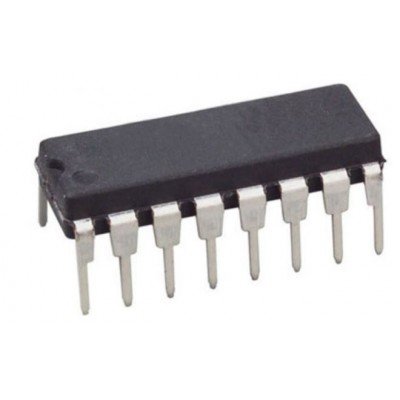
74HC4053 Triple 2-channel Multiplexer/Demultiplexer IC DIP-16 Package
The 74HC4053; 74HCT4053 is a high-speed Si-gate CMOS device and is pin compatible with the HEF4053B. It is specified in compliance with JEDEC standard no. 7A.The 74HC4053; 74HCT4053 is triple 2-channel analog multiplexer/demultiplexer with a common enable input (E). Each multiplexer/demultiplexer has two independent inputs/outputs (nY0 and nY1), a common input/output (nZ) and three digital select inputs (Sn). With E LOW, one of the two switches is selected (low-impedance ON-state) by S1 to S3. With E HIGH, all switches are in the high-impedance OFF-state, independent of S1 to S3. VCC and GND are the supply voltage pins for the digital control inputs (S0 to S2, and E). The VCC to GND ranges are 2.0 V to 10.0 V for 74HC4053 and 4.5 V to 5.5 V for 74HCT4053. The analog inputs/outputs (nY0 to nY1, and nZ) can swing between VCC as a positive limit and VEE as a negative limit. VCC VEE may not exceed 10.0 V. For operation as digitalmultiplexer/demultiplexer, VEE is connected to GND (typically ground)
The 74HC4049 is a high-speed Si-gate CMOS device and is pin compatible with the “4049” of the “4000B” series. It is specified in compliance with JEDEC standard no. 7A.The 74HC4049 provides six inverting buffers with a modified input protection structure, which has no diode connected to VCC. Input voltages of up to 15 V may therefore be used. This feature enables the inverting buffers to be used as logic level translators, which will convert high level logic to low level logic, while operating from a low voltage power supply. For example 15 V logic (“4000B series”) can be converted down to 2 V logic. The actual input switch level remains related to the VCC and is the same as mentioned in the family characteristics .At the same time each part can be used as a simple inverter without level translation
The 74HC4024 is a 7-stage binary ripple counter with a clock input (CP), an overriding asynchronous master reset input (MR) and seven fully buffered parallel outputs (Q0 to Q6). The counter advances on the HIGH-to-LOW transition of CP. A HIGH on MR clears all counter stages and forces all outputs LOW, independent of the state of CP. Each counter stage is a static toggle flip-flop. Schmitt-trigger action in the clock input makes the circuit highly tolerant to slower clock rise and fall times. Inputs include clamp diodes. This enables the use of current limiting resistors to interface inputs to voltages in excess of VCC.
Applications :-
- Frequency dividing circuits
- Time delay circuits
The 74HC4016 is a quad single pole, single throw analog switch. Each switch features two input/output terminals (nY and nZ) and an active HIGH enable input (nE). When nE is LOW, the analog switch is turned off. Inputs include clamp diodes. This enables the use of current limiting resistors to interface inputs to voltages in excess of VCC.
The 74HC40105 is a first-in/first-out (FIFO) "elastic" storage register that can store 16 4-bit words. It can handle input and output data at different shifting rates. This feature makes it particularly useful as a buffer between asynchronous systems. Each word position in the register is clocked by a control flip-flop, which stores a marker bit. A logic 1 signifies that the data at that position is filled and a logic 0 denotes a vacancy in that position. The control flip-flop detects the state of the preceding flip-flop and communicates its own status to the succeeding flip-flop. When a control flip-flop is in the logic 0 state and sees a logic 1 in the preceding flip-flop, it generates a clock pulse. The clock pulse transfers data from the preceding four data latches into its own four data latches and resets the preceding flip-flop to logic 0. The first and last control flip-flops have buffered outputs. All empty locations "bubble" automatically to the input end, and all valid data ripples through to the output end. As a result, the status of the first control flip-flop (data-in ready output - DIR) indicates if the FIFO is full. The status of the last flip-flop (data-out ready output - DOR) indicates whether the FIFO contains data. As the earliest data is removed from the bottom of the data stack (output end), all data entered later will automatically ripple toward the output. Inputs include clamp diodes that enable the use of current limiting resistors to interface inputs to voltages in excess of VCC.
The 74HC40103 is a high-speed Si-gate CMOS device and are pin compatible with the 40103 of the 4000B series. The 74HC40103 is specified in compliance with JEDEC standard no. 7A. The 74HC40103 consists of an 8-bit synchronous down counter with a single output which is active when the internal count is zero. The 74HC40103 contains a single 8-bit binary counter and has control inputs for enabling or disabling the clock (CP), for clearing the counter to its maximum count and for presetting the counter either synchronously or asynchronously. All control inputs and the terminal count output (TC) are active-LOW logic .In normal operation, the counter is decremented by one count on each positive-going transition of the clock (CP). Counting is inhibited when the terminal enable input (TE) is HIGH. The terminal count output (TC) goes LOW when the count reaches zero if TE is LOW, and remains LOW for one full clock period. When the synchronous preset enable input (PE) is LOW, data at the jam input (P0 to P7) is clocked into the counter on the next positive-going clock transition regardless of the state of TE. When the asynchronous preset enable input (PL) is LOW, data at the jam input (P0 to P7) is asynchronously forced into the counter regardless of the state of PE, TE, or CP. The jam inputs (P0 to P7) represent a single 8-bit binary word. When the master reset input (MR) is LOW, the counter is asynchronously cleared to its maximum count (decimal 255) regardless of the state of any other input. If all control inputs except TE are HIGH at the time of zero count, the counters will jump to the maximum count, giving a counting sequence of 256 clock pulses long. The 74HC40103 may be cascaded using the TE input and the TC output, in either a synchronous or ripple mode
The 74HC4002; 74HCT4002 is a dual 4-input NOR gate. Inputs also include clamp diodes that enable the use of current limiting resistors to interface inputs to voltages in excess of VCC
The 74HC368; 74HCT368 is a hex inverting buffer/line driver with 3-state outputs controlled by the output enable inputs (nOE). A HIGH on nOE causes the outputs to assume a high impedance OFF-state. Inputs include clamp diodes enable the use of current limiting resistors to interface inputs to voltages in excess of VCC.
The 74HC366; 74HCT366 is a hex inverting buffer/line driver with 3-state outputs controlled by the output enable inputs (OEn). A HIGH on OEn causes the outputs to assume a high impedance OFF-state. Inputs include clamp diodes. This enables the use of current limiting resistors to interface inputs to voltages in excess of VCC
The 74HC292/7292 and HC294/7294 are high speed CMOS PROGRAMMABLE DIVIDER/TIMER fabricated with silicon C2 MOS technology. They achieve the high speed operation similar to equivalent LSTTL while maintaining the CMOS low power dissipation. These devices are programmable frequency dividers. The type shave two clock inputs, either one may be used for clock gating. (see the function table). The HC292/7292 can divide from 22 to 231, and the HC294/7294 can divide from 22 to 215. The types feature an active-low clear input to initialize the state of all flip-flops. To facilitate incoming inspection, test points are provided. (TP1, TP2 and TP3 on the HC292/7292 and TP on the HC294/7294). All inputs are equipped with protection circuits against static discharge and transient excess voltage. HC292/294 have Q output with ”Totem pole” configuration and test point TP with ”Open Drain” output configuration.
HC7292/7294 have all outputs ”Totem Pole”.