
Shop fromIndia’s Most Affordable Electronics Store
from Rs.99.00
Don't miss this special opportunity today.



Showing 225–240 of 262 resultsSorted by latest

The PIC16C57 from Microchip Technology is a family of low cost, high performance, 8-bit fully static, EPROM/ROM-based CMOS micro controllers. It employs a RISC architecture with only 33 single word/ single cycle instructions. All instructions are single cycle except for program branches which take two cycles. The PIC16C57 delivers performance in an order of magnitude higher than its competitors in the same price category. The 12-bit wide instructions are highly symmetrical resulting in 2:1 code compression over other 8-bit micro controllers in its class. The easy to use and easy to remember instruction set reduces development time significantly. The PIC16C57 products are equipped with special features that reduce system cost and power requirements. The Power-on Reset (POR) and Device Reset Timer (DRT) eliminate the need for external RESET circuitry. There are four oscillator configurations to choose from, including the power saving LP (Low Power) oscillator and cost saving RC oscillator. Power saving SLEEP mode, Watchdog Timer and Code Protection features improve system cost, power and reliability. The UV erasable CERDIP packaged versions are ideal for code development, while the cost effective One Time Programmable (OTP) versions are suitable for production in any volume. The customer can take full advantage of Microchip’s price leadership in OTP micro controllers, while benefiting from the OTP’s flexibility. The PIC16C57 supported by a full featured macro assembler, a software simulator, an in-circuit emulator, a low cost development programmer and a full featured programmer. All the tools are supported on IBMÒ PC and compatible machines.

CD4010 Hex Buffer/Converters may be used as CMOS to TTL or DTL logic-level converters or CMOS high-sink-current drivers.
The CD4010 types are supplied in 16-lead hermetic dual-in-line ceramic packages (F3A suffix), 16-lead dual-in-line plastic packages (E suffix)

CD4009 Hex Buffer/Converters may be used as CMOS to TTL or DTL logic-level converters or CMOS high-sink-current drivers.
The CD4009 types are supplied in 16-lead hermetic dual-in-line ceramic packages (F3A suffix), 16-lead dual-in-line plastic packages (E suffix).

CD4008 types consist of four full adder stages with fast look ahead carry provision from stage to stage. Circuitry is included to provide a fast “parallel-carry-out” but to permit high-speed operation in arithmetic sections using several CD4008's. CD4008 inputs include the four sets of bits to be added, A1 to A4 and B1 to B4, in addition to the “Carry In” bit from a previous section. CD4008 outputs include the four sum bits, S1 to S4. In addition to the high speed “parallel-carryout” which may be utilized at a succeeding CD4008 section.

The PIC16C554 is powerful (200 nanosecond instruction execution) yet easy-to-program (only 35 single word instructions) CMOS OTP-based 8-bit micro controller packs Microchip’s powerful PIC® architecture into an 18-pin package. Easily adapted for automotive, industrial, appliances and consumer entry-level product applications.

CD4007 IC is comprised of three n-channel and three p-channel enhancement-type MOS transistors. The transistor elements are accessible through the package terminals to provide a convenient means for constructing the various typical circuits.
More complex functions are possible using multiple packages. Numbers shown in parentheses indicate terminals that are connected together to form the various configurations listed.
The CD4007 types are supplied in 14-lead hermetic dual-in-line ceramic packages (F3A suffix), 14-lead dual-in-line plastic packages (E suffix), 14-lead small-outline packages (M, MT, M96, and NSR suffixes), and 14-lead thin shrink small-outline packages (PW and PWR suffixes).

CD4001 NOR gates provide the system designer with direct implementation of the NOR function and supplement the existing family of CMOS gates. All inputs and outputs are buffered.
The CD4001 types are supplied in 14-lead hermetic dual-in-line ceramic packages (F3A suffix).
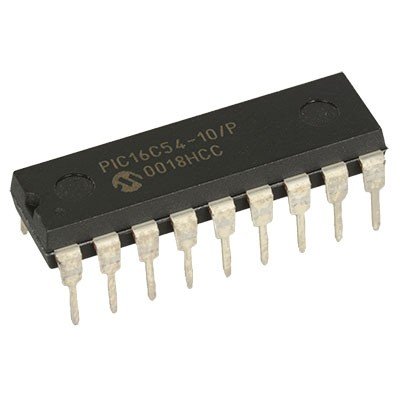
The PIC16C54 is powerful (200 nanosecond instruction execution) yet easy-to-program (only 33 single-word instructions) FLASH-based 8-bit micro controller packs Microchip’s powerful PICmicro® architecture into an 18-pin package. Easily adapted for automotive, industrial, appliances and consumer entry-level product applications.

The PIC12F675 has a 13-bit program counter capable of addressing an 8K x 14 program memory space. The data memory is partitioned into two banks, which contain the General Purpose Registers and the Special Function Registers. The register file is organized as 64 x 8 in the PIC12F675 device. Each register is accessed, either directly or indirectly, through the File Select Register FSR. There are as many as six general purpose I/O pins available. Depending on which peripherals are enabled, some or all of the pins may not be available as general purpose I/O. In general, when a peripheral is enabled, the associated pin may not be used as a general purpose I/O pin.

ATtiny85 is a small 8-pin microcontroller from Atmel and is based on Atmel's 8-bit RISC architecture. ATtiny85 is a high-performance, low-power microcontroller which combines 8KB ISP flash memory, 512B EEPROM, 512-Byte SRAM, 6 general purpose I/O lines, 32 general purpose working registers, one 8-bit timer/counter with compare modes, one 8-bit high speed timer/counter, USI, internal and external Interrupts, 4-channel 10-bit Analog to Digital converter, programmable watchdog timer with internal oscillator, three software selectable power saving modes, and debug WIRE for on-chip debugging. The device achieves a throughput of 20 MIPS at 20 MHz and operates between 2.7-5.5 volts.
By executing powerful instructions in a single clock cycle, the device achieves throughputs approaching 1 MIPS per MHz, balancing power consumption and processing speed.

ATtiny45 is a high-performance, low-power Atmel 8-bit AVR RISC-based microcontroller combines 4KB ISP flash memory, 256-Byte EEPROM, 256B SRAM, 6 general purpose I/O lines, 32 general purpose working registers, one 8-bit timer/counter with compare modes, one 8-bit high speed timer/counter, USI, internal and external Interrupts, 4-channel 10-bit Analog to Digital converter, programmable watchdog timer with internal oscillator, three software selectable power saving modes, and debugWIRE for on-chip debugging. The device achieves a throughput of 20 MIPS at 20 MHz and operates between 2.7-5.5 volts.
By executing powerful instructions in a single clock cycle, the device achieves throughputs approaching 1 MIPS per MHz, balancing power consumption and processing speed.

The high-performance, low-power Atmel 8-bit AVR RISC-based microcontroller combines 2KB ISP flash memory, 128B ISP EEPROM, 128B internal SRAM, universal serial interface (USI), full duplex UART, and debugWIRE for on-chip debugging. The device supports a throughput of 20 MIPS at 20 MHz and operates between 2.7-5.5 volts.
By executing powerful instructions in a single clock cycle, the device achieves throughputs approaching 1 MIPS per MHz, balancing power consumption and processing speed.

The high-performance, low-power Atmel 8-bit AVR RISC-based microcontroller combines 2KB ISP flash memory, 128B ISP EEPROM, 128B internal SRAM, universal serial interface (USI), full duplex UART, and debugWIRE for on-chip debugging. The device supports a throughput of 20 MIPS at 20 MHz and operates between 2.7-5.5 volts.
By executing powerful instructions in a single clock cycle, the device achieves throughputs approaching 1 MIPS per MHz, balancing power consumption and processing speed.

Atmel ATTINY13A-PU is AVR TINY series 8 pin DIP microcontroller, packed with high performance, low power 8 bit Advanced RISC Architecture. Its operational Voltage limit is 1.8V to 5.5V. It has 20 MHz CPU Clock, 6 general purpose I/O lines, 1KB ISP flash memory, 64B EEPROM, 60-Byte RAM. It has 1 timer, 2 PWM Channel, 4 Channel ADC inputs and a Watchdog. Operational Temperature range of this microcontroller is -40 to 85 degree C. Internal clock and ISP programming support by SPI protocol. Being small in size and DIP, it is particularly suitable for bread board applications and prototype development.

Atmega8A is a high-performance, low-power Atmel 8-bit AVR RISC-based microcontroller combines 8KB ISP flash memory, 1KB SRAM, 512B EEPROM, an 7-channel/10-bit A/D converter (TQFP and QFN/MLF), and debugWIRE for on-chip debugging. The device supports a throughput of 16 MIPS at 16 MHz and operates between 4.5-5.5 volts..
By executing powerful instructions in a single clock cycle, the device achieves throughputs approaching 1 MIPS per MHz, balancing power consumption and processing speed.

The PIC12F629 has a 13-bit program counter capable of addressing an 8K x 14 program memory space. The data memory is partitioned into two banks, which contain the General Purpose Registers and the Special Function Registers. The register file is organized as 64 x 8 in the PIC12F629 device. Each register is accessed, either directly or indirectly, through the File Select Register FSR. There are as many as six general purpose I/O pins available. Depending on which peripherals are enabled, some or all of the pins may not be available as general purpose I/O. In general, when a peripheral is enabled, the associated pin may not be used as a general purpose I/O pin.